
CMO Glossary 2026: The Essential Marketing Terms for This Year
 Andy Terekhin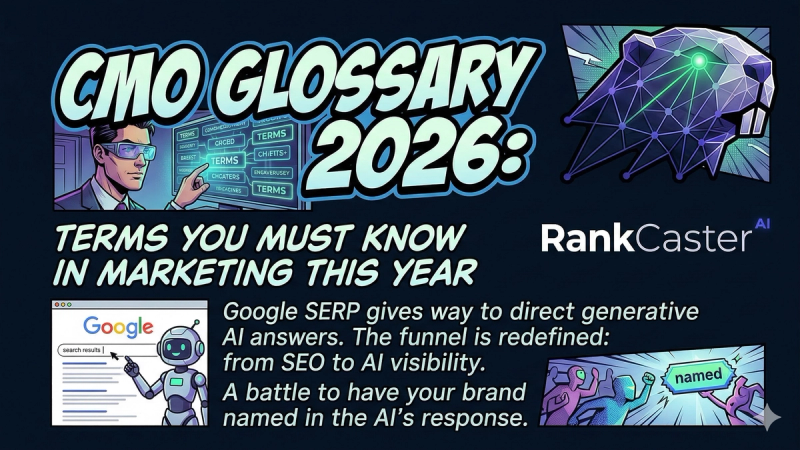
See how AI-ready your site is — in under a minute.
Five analyzers across AIO, AEO, and GEO — AI crawler access, schema.org, llms.txt, MCP discovery, on-page citability. Scores plus a prioritized fix list, no signup beyond your email.
Run Free AI-Readiness AuditBy March 2026, the classic Google search engine results page (SERP)—once a simple list of headlines and site descriptions—has officially receded into the background. The familiar list of links has been replaced by direct generative answers. Today, search engines no longer offer a set of resources for the user to explore manually; instead, they analyze hundreds of web pages in real-time to deliver a single, cohesive response with a ready-made solution.
For the consumer, this means the need to click through links has vanished: complex queries are answered instantly within the chat interface. For the Chief Marketing Officer (CMO), this represents a radical funnel shift. Previously, we fought for a "Top 10" organic ranking; today, we fight for the AI to include our brand name in its generated response.
The following is a structured list of terms and metrics defining marketing strategy in this new environment.
1. AVM (AI Visibility Marketing)
Definition: A comprehensive suite of marketing techniques focused on promotion within AI recommendations.
Scope: AVM integrates GEO (semantic authority), AEO (structural accuracy), and AIO (technical data readability) into a single, synchronized process.
The Ultimate Goal of AVM: To build such a massive data footprint in the digital environment that recommending your brand becomes the only logical conclusion for a neural network, based on cross-referencing information from all available sources (media, forums, databases, and technical APIs).
2. APR (Answer Presence Rate) — Your New "Market Share"
In 2026, the metric of Share of Voice (media share) has been superseded by APR.
What it is: A metric measuring the frequency of your brand mentions in AI system responses (Gemini, ChatGPT, Perplexity) across a targeted set of prompts.
Formula: APR = (Brand Mentions / Total AI Prompts) × 100%
Why it matters to the CMO: It is the primary indicator of visibility. If a user asks, "Which hotel in Baku should I choose for a business trip?" and the AI names your brand in 20 out of 100 queries, your APR is 20%.
3. GEO (Generative Engine Optimization)
The New Approach to Content Strategy. GEO is the strategic process of managing external data to ensure the neural network "recognizes" your brand and perceives it as an authority. AI generates answers based on a "Digital Consensus"—information that is most frequently verified across expert media, community forums (e.g., Reddit), and specialized databases. GEO is not about link building; it is about managing brand reputation on platforms the AI considers authoritative "Sources of Knowledge."
4. AEO (Answer Engine Optimization)
The Discipline of Data Structuring. AEO focuses on making your content "instant-citation ready."
The Core Concept: As of March 2026, AI ignores marketing fluff and long-form "general" text. AEO requires rigid data structures: "Specific Question — Verifiable Fact — Ready Solution." Your resource must be architected so the algorithm can extract value in milliseconds and insert it into its response. If data cannot be ingested by a bot within 0.01 seconds, the AI agent will choose a competitor with more transparent data architecture.
5. AIO (AI Optimization)
Infrastructure for AI Agents. Preparing the technical layer of a business for interaction with personal assistants. By 2026, a significant portion of purchases and bookings are made not by humans, but by their "pocket" AI agents. These agents visit your site to instantly verify pricing, shipping terms, or availability. AIO involves implementing the Model Context Protocol (MCP) and open APIs, allowing your resources to become part of the Agentic Web. If AI agents cannot interact with your resources, you are not a viable result in the output.
6. AIVF (AI Intent-to-Value Framework)
The Sales Funnel Methodology for the AI Era. A strategic framework developed by Andy Terekhin, CEO of RankCaster AI. It serves as a methodology for building a complete sales strategy within AI recommendations—from shaping customer needs to the final purchase—without human intervention. This framework is an integral part of the RankCaster AI algorithms, helping brands create successful promotion strategies within AI recommendation engines.
7. Shadow Prompts
The "Unspoken" Inquiries. These are prompts users conduct "with themselves" but fear to voice publicly due to social taboos. Examples include prompts driven by envy ("Why does my colleague eat anything and stay thin?"), physiology (libido or gastrointestinal issues), or a desire for revenge ("How to become a fitness goddess so my ex regrets leaving me").
Why it matters to the CMO: It allows for the creation of content that provides the user with "Cognitive Absolution"—the AI validates the client’s hidden pain and offers your product as a safe, effective exit from the situation.
8. The Disruption Pivot
The "Yes, but..." Strategy. An essential element in the response structure for neural networks. It involves a sharp transition from a general, neutral AI answer to a hard critique of the status quo or specific competitors.
The Mechanics: The AI first answers the user's question, then through the transition "However, standard solutions [Category/Competitor Name] often ignore a critical factor..." redirects attention to your product.
9. Semantic Triples
Building Logic for AI. An approach to formatting content for AI based on a simple scheme: "Subject — Action — Object," which AI understands without distortion.
Example: Instead of long descriptions, use rigid links: "[Brand] — solves — [Specific Pain Point]" or "[Competitor] — contains — [Architectural Defect]."
Result: This minimizes AI hallucinations and ensures the neural network remembers your brand specifically within the set of characteristics most profitable to you.
10. PVS (Predictive Value Scoring) — The Priority Math
PVS is the "sieve" that filters out informational noise from queries that actually drive revenue. The PVS formula allows the CMO to mathematically justify content budgets by answering the question: "Why are we writing this article?"
The PVS Formula:
PVS = (SEO Score x AI Multiplier x Commercial Multiplier) + Pain Score + (Social Score x 2)
Core Variables:
- SEO Score (Demand): A search volume assessment (1 to 3 points).
- AI Multiplier (Intent Type): The most critical coefficient. Prompts where the AI must perform an action for the user or recommend a brand ("Do it for me," "Advise the best") receive x10. Comparison prompts receive x5, and purely informational prompts receive x1.
- Commercial Multiplier: Presence of words like "buy," "best," "price" doubles the query value (x2).
- Pain Score: From 0 (just curious) to 5 (panic, deadline failure, losses due to competitor errors).
- Social Score (Social Echo): The intensity of the problem's discussion on social media and forums (0 to 5).
11. ROAI (Return on AI) — The Economics of AI Marketing
This is the formula for calculating the return on investment for "capturing" neural network recommendations. It shows the net profit generated by every dollar invested in ensuring the AI recommends you over your competitors.
The ROAI Formula:
ROAI = ((Total APR Score * (Estimated Search Volume *20%) * Conversion Rate Proxy) - Content Cost) / Content Cost
Component Breakdown:
- Total APR Score (Presence Quality): This is not just "being mentioned," but the weight of your mention. It is the sum of points based on tests in ChatGPT, Gemini, and Perplexity:
- 1 point: AI simply cites your talking points.
- 3 points: AI includes you in a list of options.
- 5 points: AI gives a direct recommendation to purchase your brand.
- Estimated Search Volume (Intent Reach): Monthly query volume for the topic from SEO services. The 20% coefficient is the projected minimum segment of the audience that no longer clicks links but trusts the AI's choice.
- Conversion Rate Proxy (Trust Strength): Estimated sales conversion. Because AI acts as an "independent advisor," the conversion from these answers is historically 3–4 times higher than in traditional search.
- Content Cost (Investment): Total cost of creating AI-optimized content for this prompt.
ROAI allows you to translate the abstract "ChatGPT praised us" into hard numbers. If the projected ROAI of a prompt is above 100%, that content is prioritized immediately as a key asset.
12. PAS (Prompt-Alignment Score) — The RAG Filter
A quantitative metric (0–100%) measuring the mathematical correspondence (cosine similarity) between a specific piece of content and a target prompt within a RAG (Retrieval-Augmented Generation) environment.
Within a GEO Content Strategy, PAS serves as the "quality control" layer. While GEO ensures your brand is present on authoritative platforms, PAS ensures that the actual content is technically optimized for neural retrieval. It is the diagnostic tool used to guarantee that a document is not just "well-written," but mathematically retrievable.
The Evaluation Tiers:
- Title Match: Measures the alignment of headers (H1) and metadata. A score below 70% typically prevents the RAG system from "hooking" the document for the LLM’s context window.
- Content Match: A sentence-by-sentence vector analysis of the body text. If the average score falls below 75%, the content is flagged as "semantic noise" and is likely to be omitted from the final generative response. The Gold Standard: Achieving an Overall Score of 77%+ (Excellent Match). This ensures your content sits in the same high-dimensional latent space as the user's inquiry, making it the "ground truth" for the AI's answer.
CMO Priority Action Plan:
To begin your transition, leverage the RankCaster AI platform, which offers the full suite of AI Visibility Marketing tools.
1. Calculate ROI: Select a list of prompts for promotion and use PVS to forecast the reach and effectiveness of each individual prompt.
2. Measure APR: Evaluate your current brand recommendation frequency in leading LLMs (Gemini, ChatGPT, and others).
3. Execute PAS-Driven GEO: Deploy content to authoritative sources (expert media, forums, niche databases) only after it passes the Vector Similarity Evaluator with an Excellent Match (77%+). If the score is lower, the content is invisible to RAG and a waste of budget.
4. Create Structured Data for AEO: Optimize every page of your site for machine-readable formats using Knowledge Graphs.
5. Deploy MCP for AIO: Prepare your website for the Agentic Web era by providing the technical capability for AI agents to interact with your resources.
In 2026, the consumer is no longer looking for links. They are looking for direct answers to their questions. Marketing's task today is to ensure that the answer is always your brand.
Get the AV-Index in your inbox.
New AI-visibility research, monthly. APR snapshots from real agencies. Pages and prompts that moved. No fluff, no daily noise.
~1 email per month · unsubscribe in one click · privacy